Demystifying the Role of the RTE in SAFe: Beyond Coordination to Leadership
In the Scaled Agile Framework (SAFe), the Release Train Engineer (RTE) is often mistaken for a high-powered project coordinator—someone who simply runs Program Increment (PI) Planning events and ensures meetings start on time. But this view does a disservice to one of the most dynamic and strategic roles in SAFe.
In our recent webinar, “Demystify Role of RTE in SAFe,” we unpacked the multifaceted role of the RTE and revealed how they operate as servant leaders, delivery coaches, flow optimizers, and strategic enablers. If you're navigating a Lean-Agile transformation or scaling Agile across the enterprise, understanding the true power of the RTE role is essential to driving sustainable success.
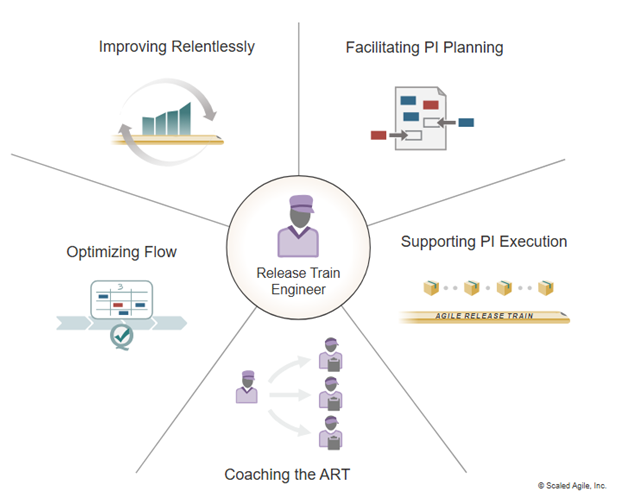
The responsibilities of a RTE can be shown as follows:
The RTE: More Than a Facilitator
At its core, the RTE is the servant leader and coach of the Agile Release Train (ART). They ensure that key ART ceremonies—like PI Planning, ART Sync, System Demos, and Inspect & Adapt—run efficiently. But they do much more than keep events on the calendar.
An effective RTE is a catalyst for alignment, value delivery, and culture change. They create an environment where impediments are surfaced and resolved quickly, risks are managed transparently, and the train operates as a cohesive unit with a shared mission. They’re also instrumental in supporting broader Lean-Agile transformation efforts, helping to embed principles of agility into leadership behavior, team dynamics, and cross-functional collaboration.
Facilitating PI Planning: The Heartbeat of ART Execution
- PI Planning is one of the most visible responsibilities of the RTE—and one of the most critical. As the conductor of this high-stakes, enterprise-level planning event, the RTE ensures:
- Alignment: They ensure that outputs from Continuous Exploration feed into PI Planning and that the Product Management vision is understood across the ART.
- Inputs & Outputs: RTEs guide the preparation of business context, roadmaps, and prioritized features, and they ensure the outputs—committed PI Objectives and ART planning boards—are clearly documented and communicated.
- Stakeholder Engagement: From inviting key participants (including shared services and X-dependency teams) to using readiness checklists, RTEs proactively manage stakeholder logistics and expectations.
- PI Planning readiness spans three core areas: A) Organizational Readiness – ensuring team structures, business alignment, and scope are clear. B) Content Readiness – including executive briefings, product and architectural vision. C) Logistics Readiness – covering location, tooling, and communication channels.
In this role, the RTE is not just enabling planning—they are activating alignment at scale.
Supporting PI Execution: Flow, Feedback, and Stakeholder Connectivity
Once the plan is in motion, the RTE takes on a different role—flow facilitator and execution coach. They monitor progress using the ART Kanban, help surface and remove impediments, and facilitate ART Syncs to maintain momentum and feedback loops.
Supporting PI Execution also involves deeper collaboration:
- Helping teams plan release milestones and align on Definition of Ready (DoR) and Definition of Done (DoD)
- Coaching DevOps maturity where needed or partnering with SPCs to accelerate continuous delivery
- Facilitating team events, retrospectives, and feedback loops to continuously improve execution quality
- An often overlooked but vital part of execution is stakeholder interaction. Here, the RTE acts as a strategic connector by: A) Aligning with Product and Solution Management to ensure roadmaps stay synchronized B) Supporting Business Owners in maintaining communication with ART teams C) Assisting in epic-level economic decision-making and operating within Lean budget guardrails
Execution isn’t just tracking progress—it’s about keeping strategy, people, and value delivery in sync.
Coaching the ART: Mentoring Mindsets and Maturing Teams
Great RTEs go beyond the mechanics of events—they shape culture. As servant leaders and mentors, they lead with empathy, build trust, and use the Socratic method to challenge teams to think critically and solve their own problems.
They coach at multiple levels:
- Team Level: Collaborating with Scrum Masters and Agile Coaches to support team events and agile maturity
- ART Roles: Coaching Business Owners, Architects, and Product Managers on effective ART leadership
- Communities of Practice (CoPs): Fostering organizational learning, sharing anti-patterns, and driving collaboration across teams
By modeling Lean-Agile leadership behaviors—growth mindset, emotional intelligence, insatiable learning—the RTE helps raise the bar for the entire train.
Optimizing Flow: Driving Measurable Value Delivery
One of the most strategic elements of the RTE role is flow optimization. As a Value Delivery Optimizer, the RTE:
- Establishes the ART Kanban to visualize and manage work-in-progress
- Applies 8 Flow Accelerators to identify bottlenecks and improve throughput
- Tracks and reports SAFe’s 6 Flow Metrics, creating visibility into delivery efficiency
- They also align with Product Management to ensure customer-centricity informs the roadmap, partner with Architecture to maintain a healthy architectural runway, and ensure Lean UX practices are part of the product development flow.
By making value flow visible and actionable, the RTE enables data-driven conversations that accelerate delivery without compromising quality.
Managing Risks and Value Streams
The RTE plays a key role in risk visibility and mitigation. They maintain the ROAM board, surface cross-team dependencies, and escalate resource constraints to the right leaders in a timely manner. Through Inspect & Adapt workshops, they help ARTs learn from the past and build more resilience into future planning.
They are also deeply involved in value stream management. By mapping out activities from ideation to implementation, identifying handoffs and delays, and quantifying active vs. wait time, the RTE provides a clear lens into system-level inefficiencies—and leads the charge in improving them.
Improve Relentlessly: The Culture of Continuous Evolution
Improvement isn’t a side gig for the RTE—it’s a central function. They facilitate retrospectives that go beyond venting, asking the right questions to spark insight and change. They conduct assessments, guide ART roles through growth journeys, and work closely with the Value Management Office (VMO) or LACE to scale learnings across the enterprise.
By embedding improvement into the rhythm of delivery, the RTE helps build high-performing, self-reflective ARTs.
Final Thoughts: The RTE as Strategic Enabler
The Release Train Engineer is not just a planner or process guide. They are a leader of flow, a coach of mindsets, and a guardian of value delivery. When empowered and supported, an RTE becomes a multiplier of agility—bridging strategic intent with executional excellence.
As organizations embrace Lean-Agile ways of working, the RTE stands at the helm—not directing from above, but enabling from within. Not by managing tasks, but by amplifying people, aligning purpose, and removing the friction that slows down value delivery.
It’s time to demystify the RTE role—and recognize it for what it truly is: one of the most impactful leadership roles in any SAFe transformation.
More Insights

Illuminating the Role of the People Manager in SAFe: From Traditional Oversight to Empowered Enablement

Revolutionizing Customer Experience with Generative AI: Personalization at Scale
Get your T Shaped Skills Going!